Churches in Sicily
The Church of the Gesù (Chiesa del Gesù - Casa professa) - the first Jesuit church in Sicily
The Church of the Gesù is one of the most important Baroque churches in Sicily. It is also known as Chiesa del Gesù, Church of Saint Mary of Gesu, Chiesa di Santa Maria di Gesù or Casa Professa.
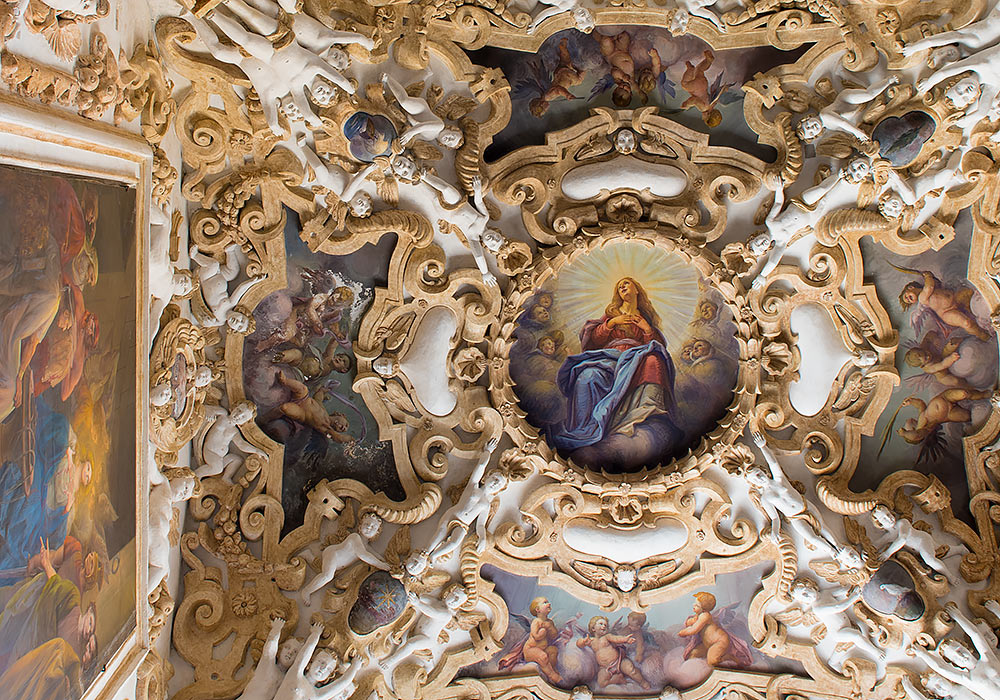
Detail of the ceiling in the Church of the Gesù (also known as Casa Professa) in Palermo, the first church to be erected by the Jesuits in Sicily (1564-1633).
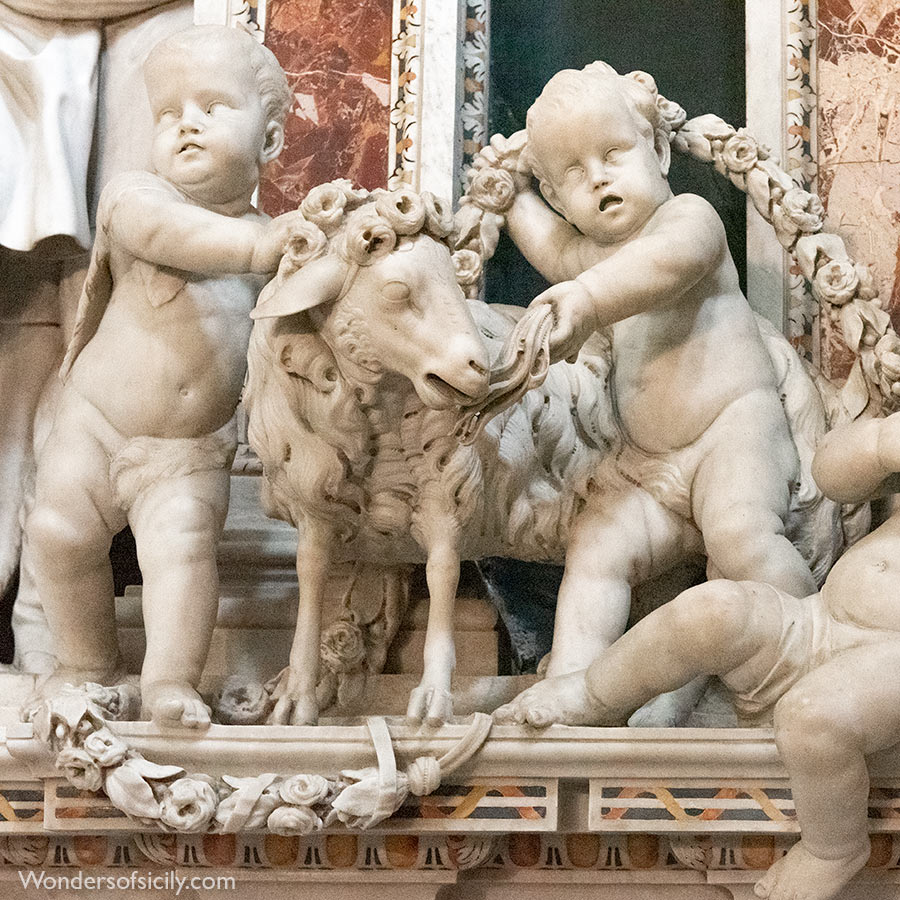
The Jesuits arrived in Palermo in 1547, and within just a few years they began laying the foundations for what would become one of the city’s most important religious and artistic landmarks. In 1549 the Viceroy Giovanni de Vega requested that an abbey be granted to them, and in 1550 Emperor Charles V officially conceded the right. By 1552 the Jesuits had taken possession of the Abbey of Santa Maria della Grotta in Palermo, moving there the following year.
In the 1560s, under the direction of Giovanni Tristano, the first plans for a new complex were drawn up. Construction began in 1564, with Francesco Costa taking over the works. By the end of 1567, much of the church and its chapels were completed. Over the following years, the Jesuits expanded their holdings, acquiring both the Palazzo Cusenza-Marchese and the church of Santi Filippo e Giacomo. Work on the dome advanced but structural problems soon appeared, leading to repeated collapses and reconstructions over the next century.
By the early 17th century, the interiors were being transformed with stone, marble, stucco, and painting, creating an extraordinary anticipation of the Sicilian Baroque style. Artists such as Vincenzo La Barbera and Orazio Ferrerano contributed to the decoration, with Ferrerano sculpting angel figures for the Chapel of the Holy Crucifix, completed in 1628. In the later decades, Lorenzo Ciprì, Giacomo Serpotta, Filippo Randazzo, and others enriched the church with frescoes, allegorical figures, marble statues, and elaborate stuccoes, establishing Casa Professa as one of Palermo’s great artistic treasures.

In this relief from Casa Professa in Palermo, two lively putti restrain a pair of rearing lions. Executed in marble with dramatic contrasts, the lions—shown with open jaws and tense bodies—embody raw destructive force, symbols of untamed passions, violence, or chaotic natural power. The putti hold the lions in check with bands or cords. Their innocence and serenity stand in deliberate contrast to the animals’ ferocity, turning the scene into an allegory of virtue overcoming brute strength, of good prevailing over evil. Within the Jesuit context of Casa Professa, the imagery conveys a moral lesson: through divine assistance, disorder and destructive impulses can be subdued and redirected toward harmony. The composition reflects the Baroque Jesuit vision, in which art dramatizes the eternal struggle between good and evil, chaos and order, ultimately resolved by grace and virtue.

This intarsia panel constitutes a notable example of Sicilian Baroque marble inlay (marmi mischi) from Casa Professa. The composition centers on a large, elaborately decorated vase enriched with scrolling foliage and surmounted by a prominent flower. Flanking the vessel are two parrots, rendered in polychrome marble and oriented toward the central axis. The ensemble is enclosed within a dense framework of vegetal ornament, a characteristic demonstration of the technical and artistic virtuosity cultivated within the Palermitan marble workshops of the Baroque period. The vase, a recurrent motif in Baroque decorative programs, often functions as a symbol of abundance, fertility, and divine grace. Within a Jesuit context, it may further be interpreted as an allusion to the Virgin Mary as the vessel of life. The parrots introduce an additional symbolic register: in Christian tradition, they were associated with the Virgin due to the belief that they could articulate the salutation Ave. More broadly, they connoted paradise and the diffusion of the Word of God, while also evoking notions of exoticism and the universality of the Catholic faith. Finally, the abundant foliage and central blossom articulate ideas of spiritual flourishing, renewal, and eternal growth, thereby uniting ornamental exuberance with theological meaning.

The composition of this intarsia panel integrates polychrome marble inlay with sculpted elements in high relief, producing a complex iconographic scheme that balances ornamental exuberance with allegorical meaning. The central zone presents two reclining youthful figures, rendered in white marble, whose downward postures suggest heaviness and human frailty. The black birds seem to prevent them from accessing the fountain of life (?) by pressing down the young men's heads. In emblematic tradition the raven carries ambivalent meanings: as a bird of ill omen and corruption, but also as an agent of providence, recalling the biblical episode in which ravens fed the prophet Elijah (1 Kings 17:6).
Beneath them, a garland of fruit restores balance to the composition. Together, the elements articulate a Baroque meditation on death, weakness, and sacrifice, resolved by the promise of grace and divine providence.

The Procopio Serpotta Oratory: The Assumption of the Virgin Mary, a central theme in Catholic art. Surrounded by angels and saints, Mary is lifted heavenward in radiant light. At the top, the Holy Trinity receives her, with Christ and God the Father enthroned and the Holy Spirit symbolized as a dove. The scene is combining dynamic movement, vivid colors, and dramatic light to emphasize the glory of the Virgin’s passage into heaven.
In the 18th century, the church continued to evolve with the construction of a bell tower, new frescoes, and modifications to the dome and floor. Recognized for its monumental value, Casa Professa was officially listed as a protected building in 1892. Giuseppe Patricolo oversaw significant restorations at the turn of the 20th century, renewing pavements and the high altar.
The church suffered devastating damage during the Allied bombing of Palermo in May 1943, when the dome was destroyed. Post-war restoration began immediately, led by Francesco Valenti, and continued into the 1950s. The mosaics, inlays, frescoes, and stuccoes were gradually restored, and in 1954 the church was solemnly reopened to the public.
Today, Casa Professa stands as a testament to the resilience of both art and faith in Palermo. Its layered history—marked by repeated rebuilding, artistic renewal, and careful restoration—offers visitors a unique journey through centuries of Sicilian architecture, devotion, and Baroque splendor.
Statue by the Gagini school of the Madonna and Jesus by the Gagini school.

Video: Documentary about the symbolism in Chiesa del Gesù
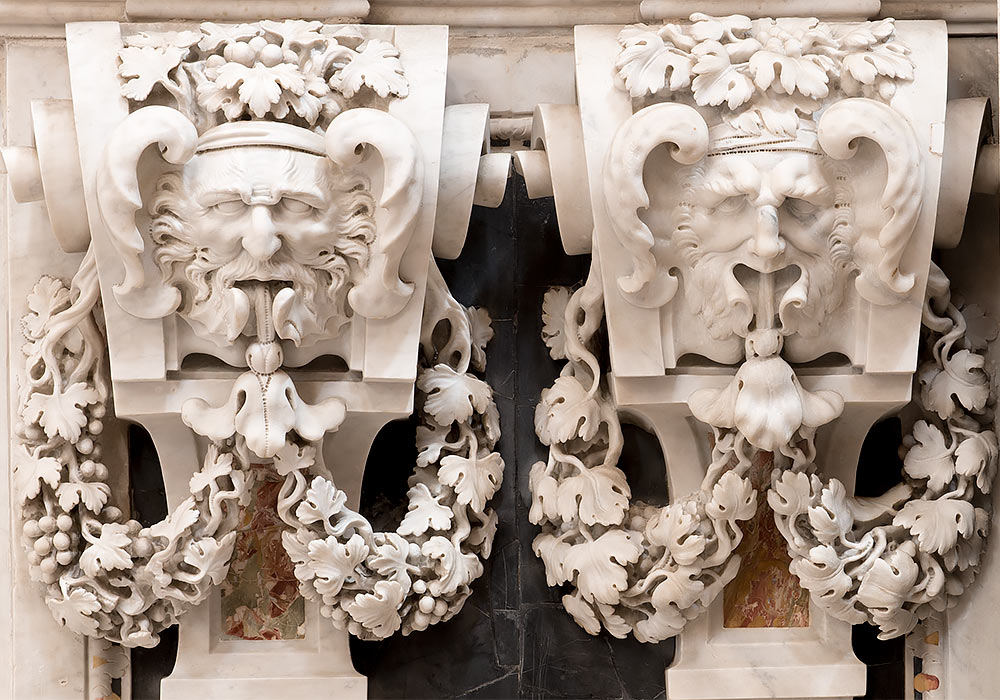
The marble reliefs with their figural and ornamental motifs in the Church of the Gesù (Chiesa del Gesù) are truly amazing.
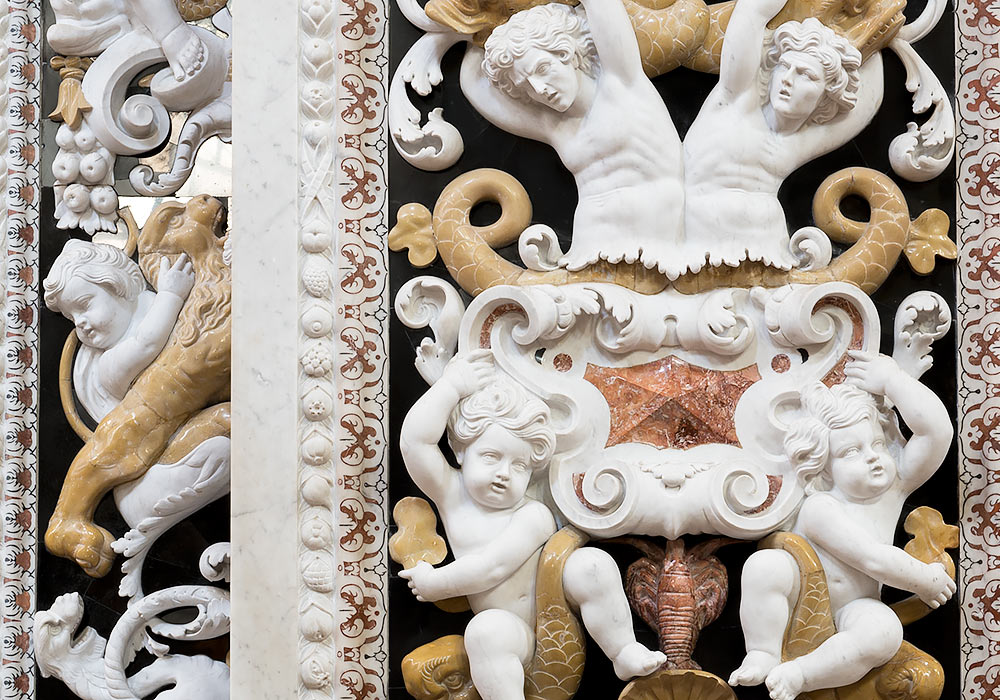
LEFT: The Pillars of Earth are positioned at the base of the arch leading to the Chapel of Saint Francis Xavier. They display terrestrial animals—including two centaurs—together with fruits, flowers, and other motifs.
RIGHT: The two Pillars of Fire flank the high altar, decorated with braziers.

More incredible decorations in the Church of the Gesù (Casa Professa). The “decorative frenzy” of the 17th (and 18th) century took the form of “dense patterns of inlaid coloured marble and hardstone (marmi mischi)”, especially in Palermo.
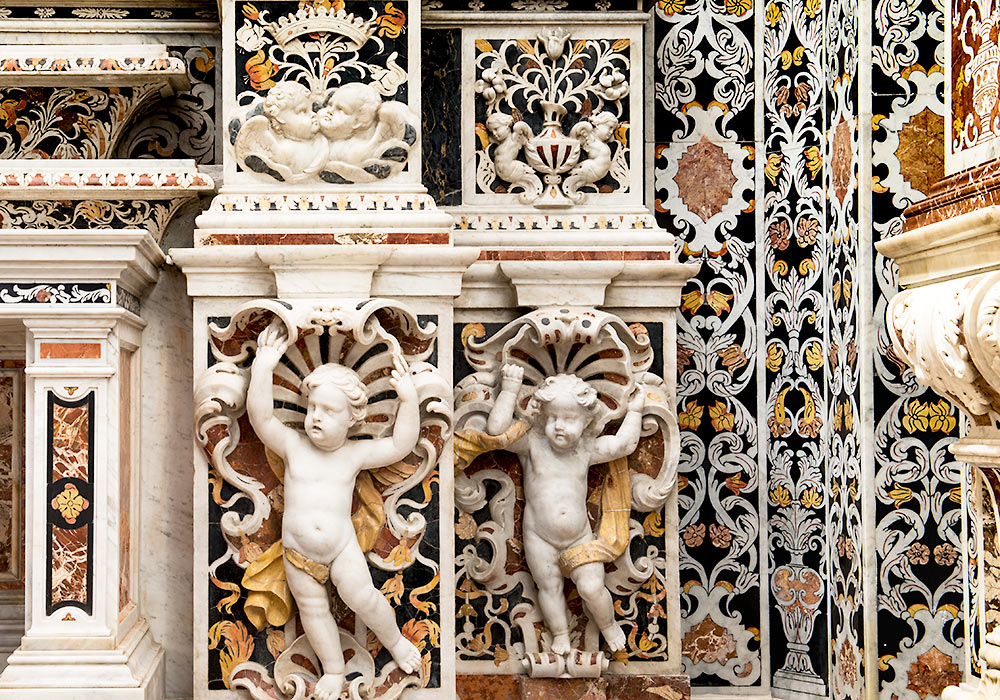
The detail on the right is part of the allegorical representation of Water. The two Pillars of Water display cascades of water, overflowing vases, shells, lobsters, eels, water birds, and seahorses.

This marble relief in Palermo’s Casa Professa shows a fallen devil, chained and writhing in defeat. Carved in white marble with bat-like wings and a contorted face, the figure embodies agony and rage beneath the victorious power of divine forces above. The sharp textures of the wings contrast with the smoothness of the flesh, while the chains underscore the theme of subjugation. Around the tortured body runs a frame of polychrome fruit and flowers, a deliberate contrast between the torments of damnation and the abundance of Paradise.
Figures like this are part of a broader Jesuit program shaped by the Counter-Reformation, where art was meant to teach, move, and even terrify. The grotesque devils scattered among the angels and saints of Casa Professa symbolize the reality of sin and the certainty of its punishment. Their defeat reflects the triumph of Christ and the Church, echoing apocalyptic visions from the Book of Revelation. For Sicilian worshippers of the 1600s, these marble images made the invisible battle of salvation visible—a vivid reminder of eternal choices and consequences.
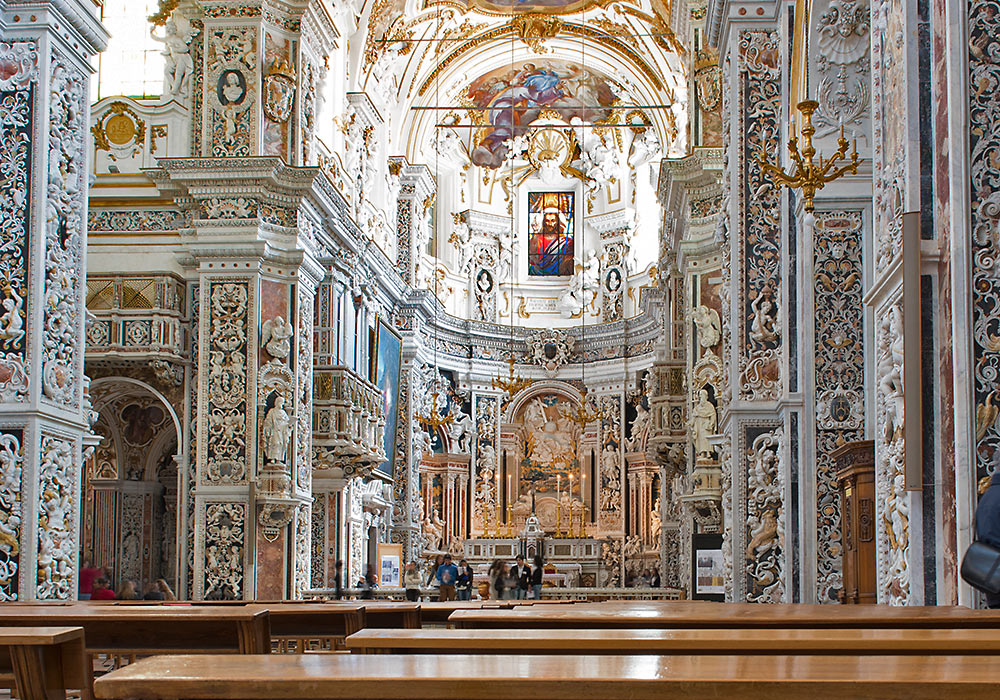
The Jesuit church of the Gesù is one of the most ornate Baroque interiors in Sicily. Every surface is covered with marble inlays, reliefs, and allegorical figures. Angels, saints, floral motifs, and grotesque devils form a vast program of images that was meant to instruct and move the faithful. It can be described as a kind of “Bible in marble,” where the battle between good and evil is vividly carved into stone.

Decorations in the Church of the Gesù (Casa Professa).
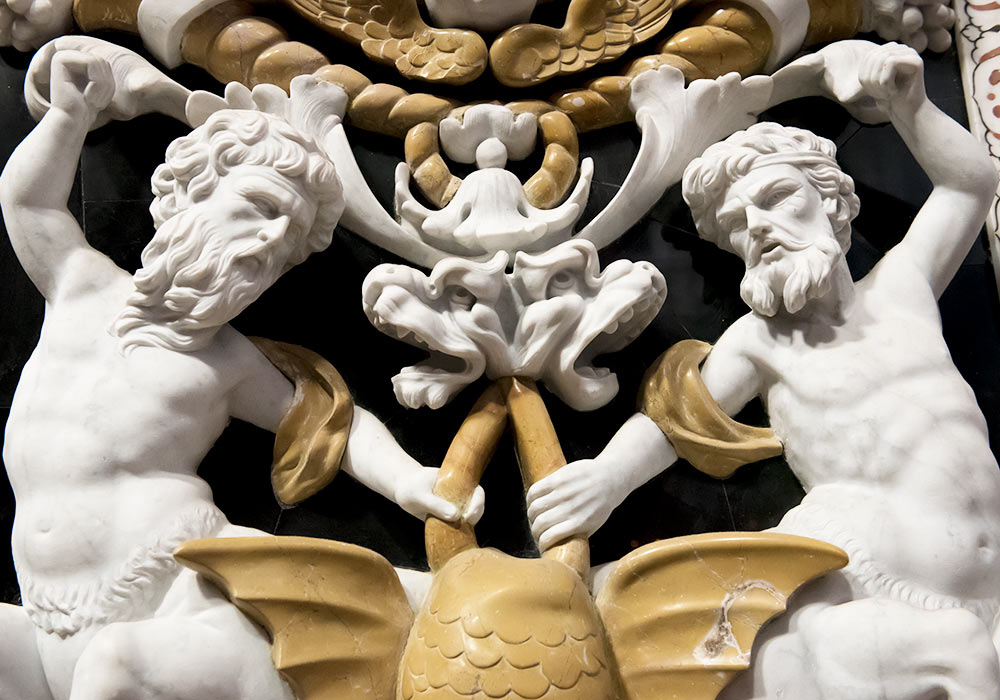
Detail of the allegorical representation of Earth. The Pillars of Earth are positioned at the base of the arch leading to the Chapel of Saint Francis Xavier. They display terrestrial animals—including two centaurs—together with fruits, flowers, and other motifs.

The jaw-dropping interior of the Church of the Gesù (Casa Professa). Goethe, though, hated the lavish decorations when he visited Palermo in 1787.
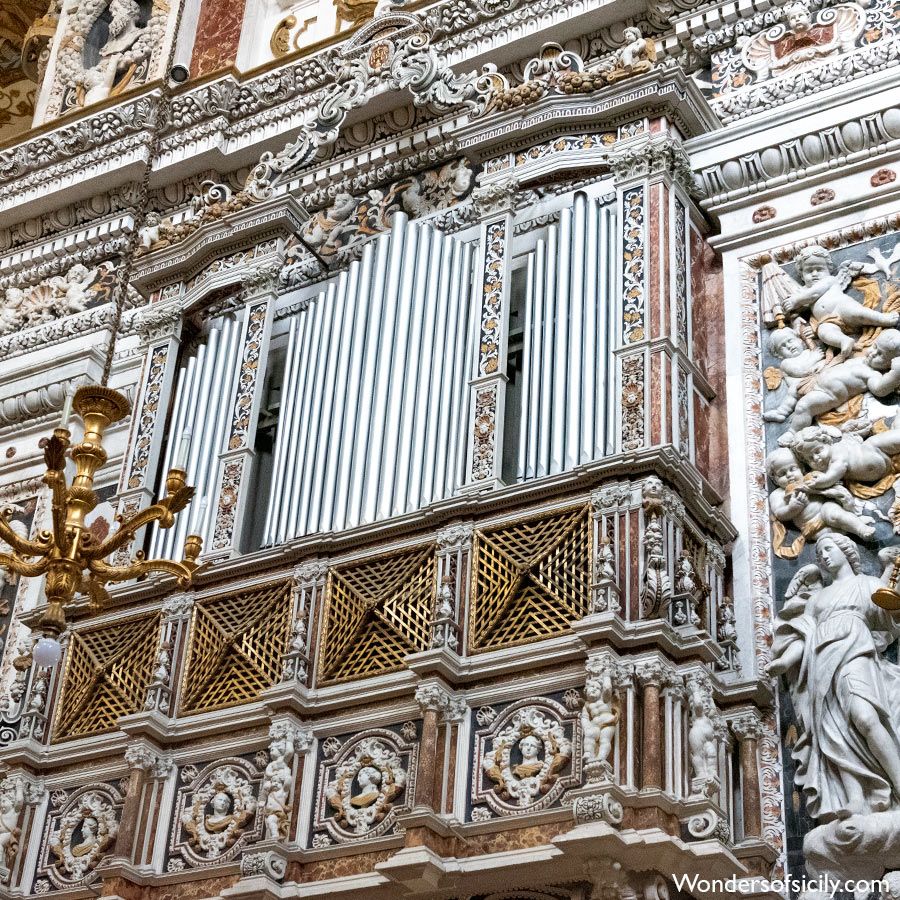
The beautiful organ in Casa professa in intact, but not working.
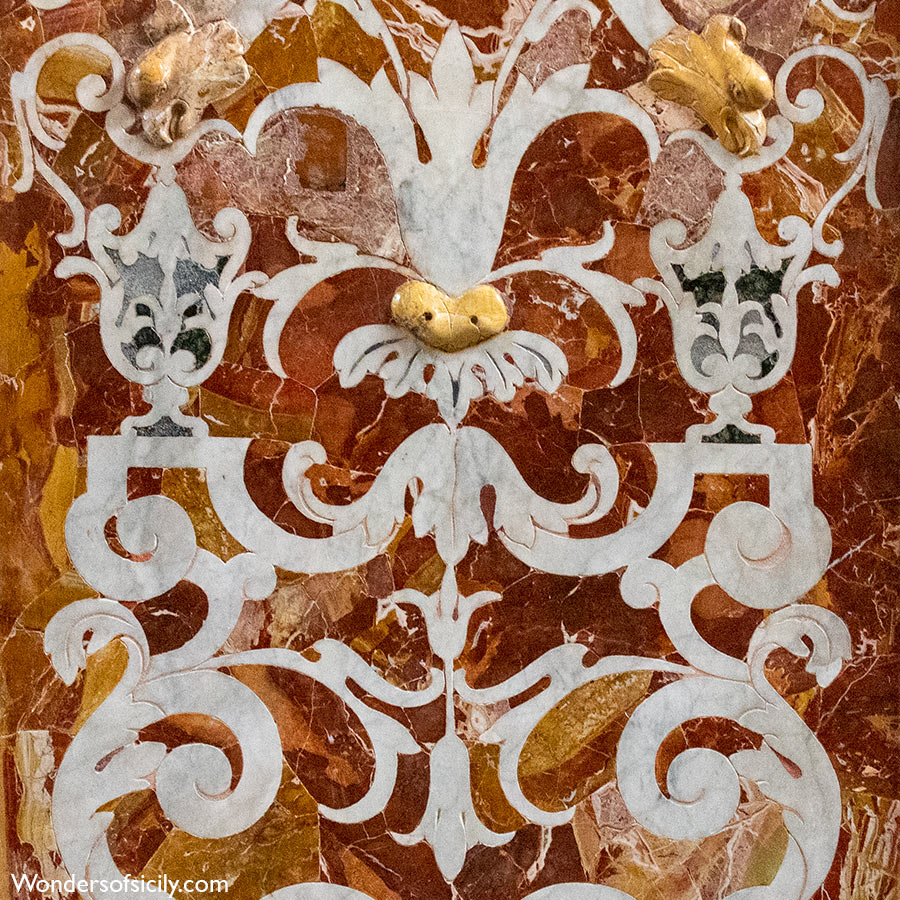
Detail of the inlaid marble in The Church of the Gesù (Chiesa del Gesù).
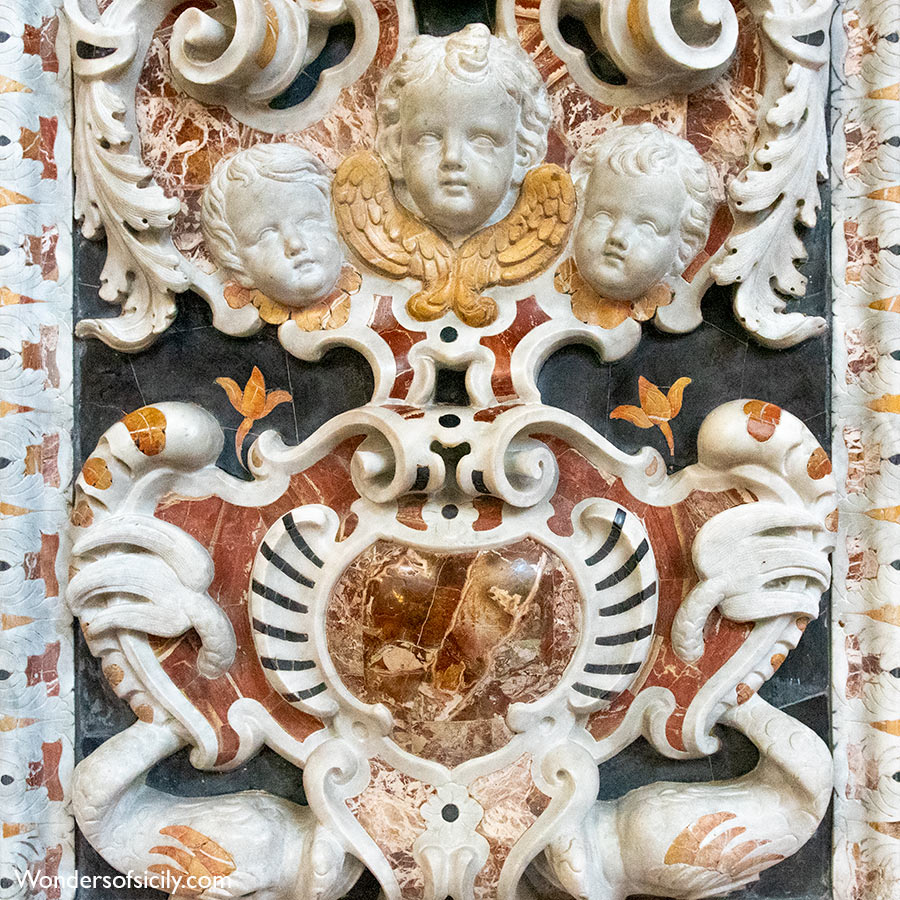
Detail of reliefs and the inlaid marble.
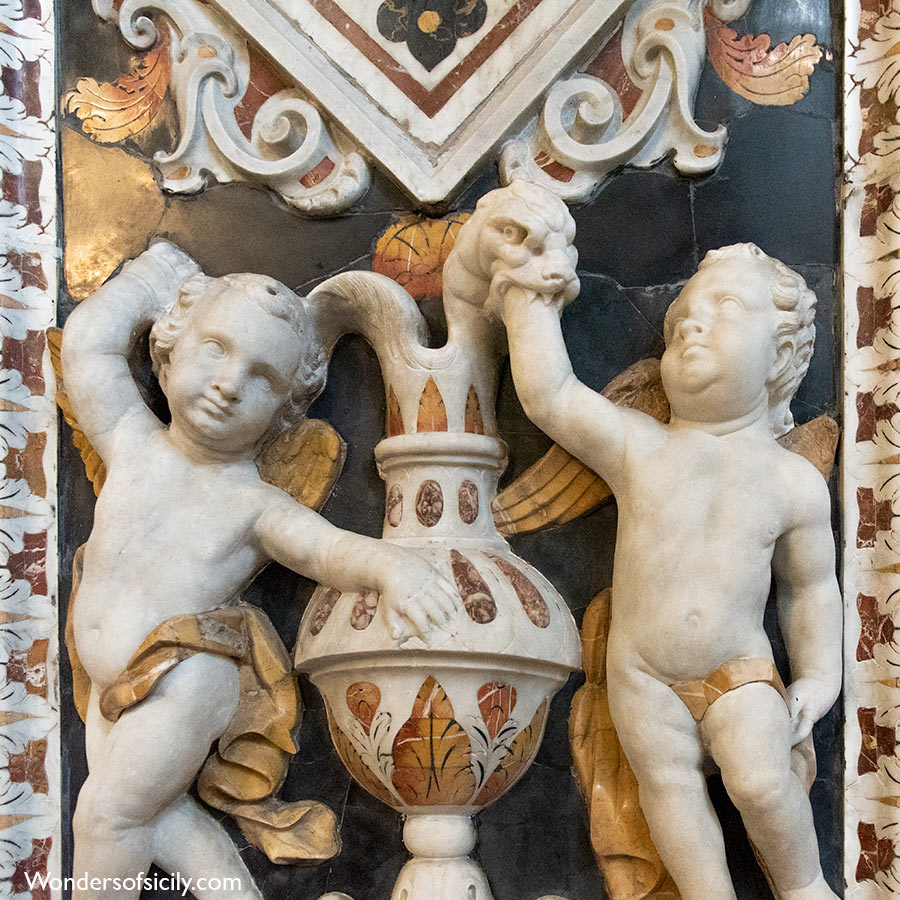
Detail of reliefs and the inlaid marble.
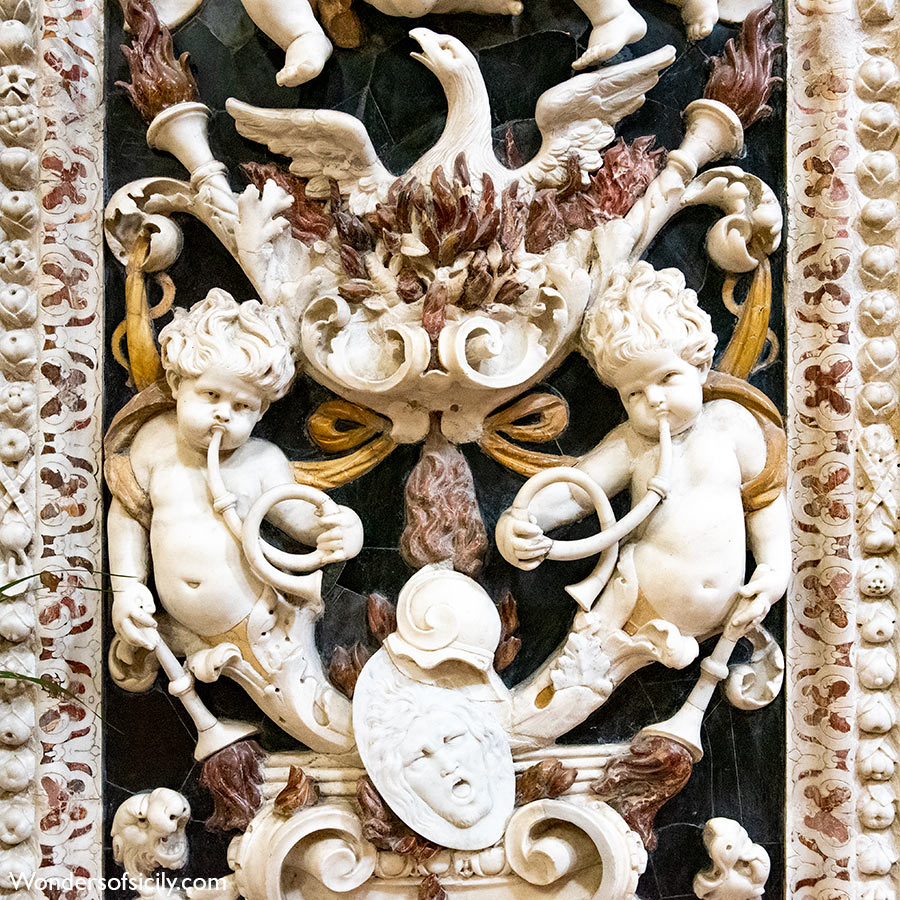
Detail of reliefs and the inlaid marble.
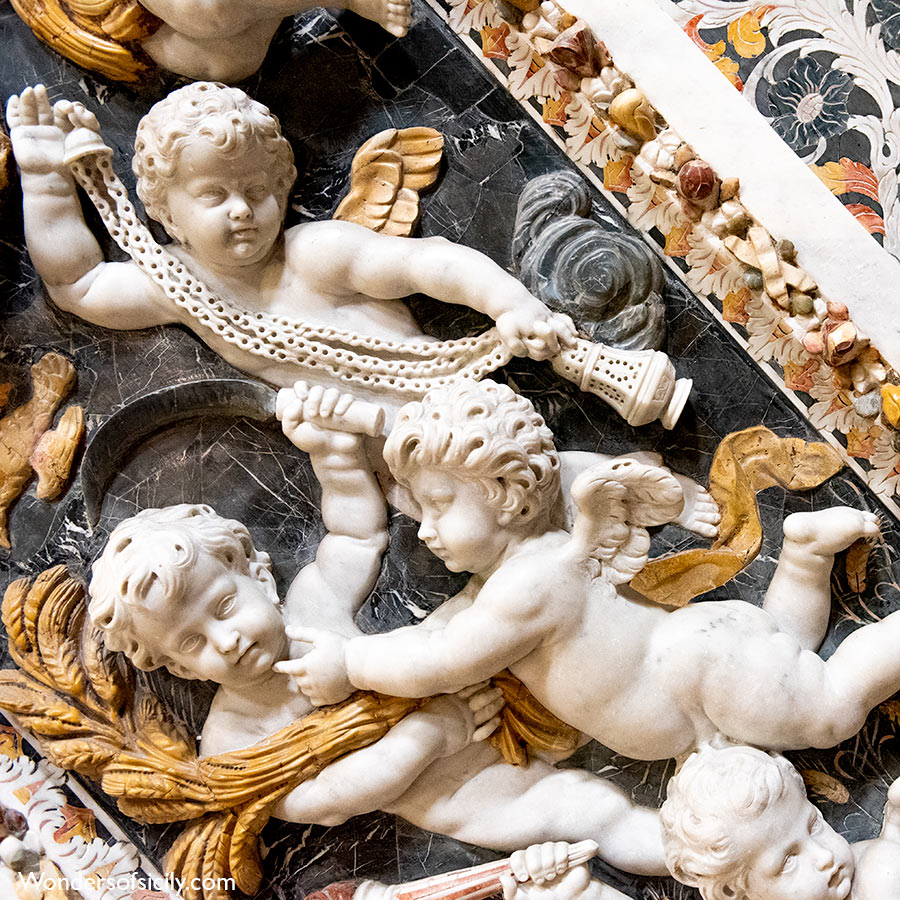
Detail of reliefs and the inlaid marble.
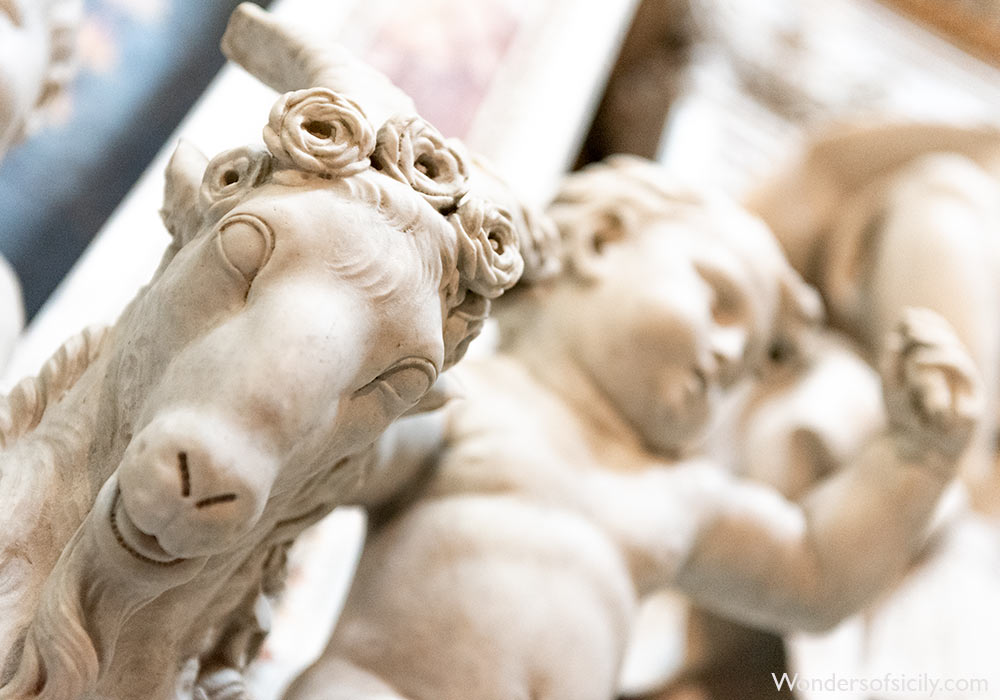
Sculptures in the Church of the Gesù.
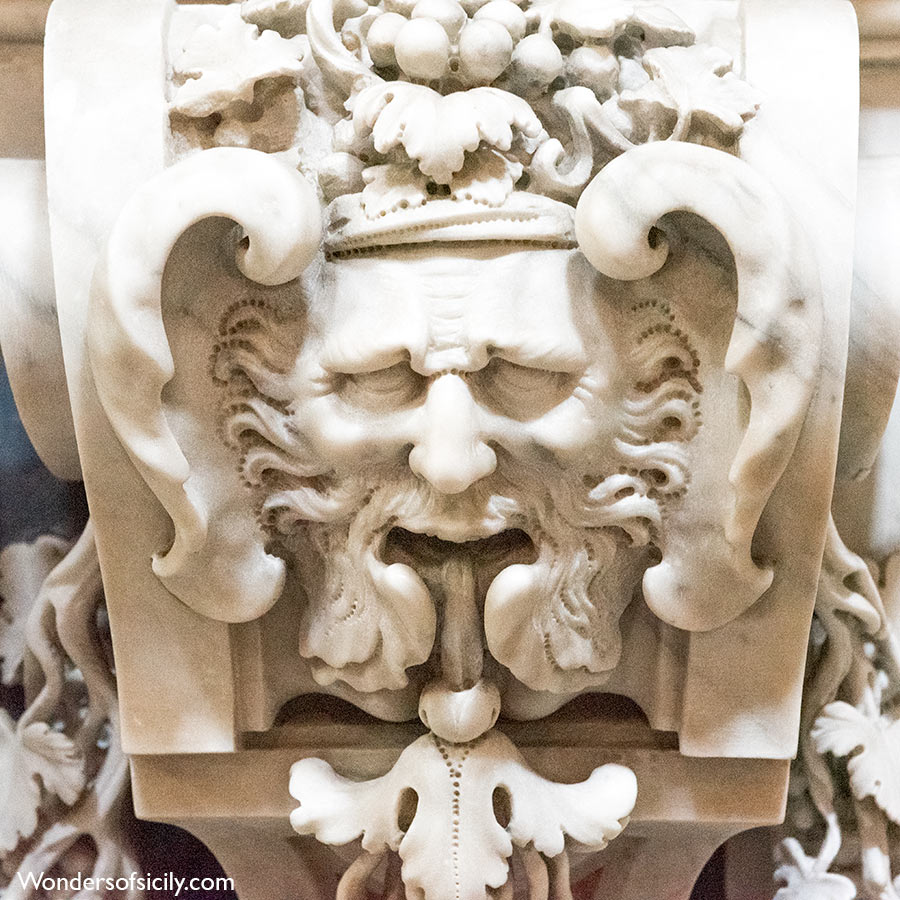
Decoration.
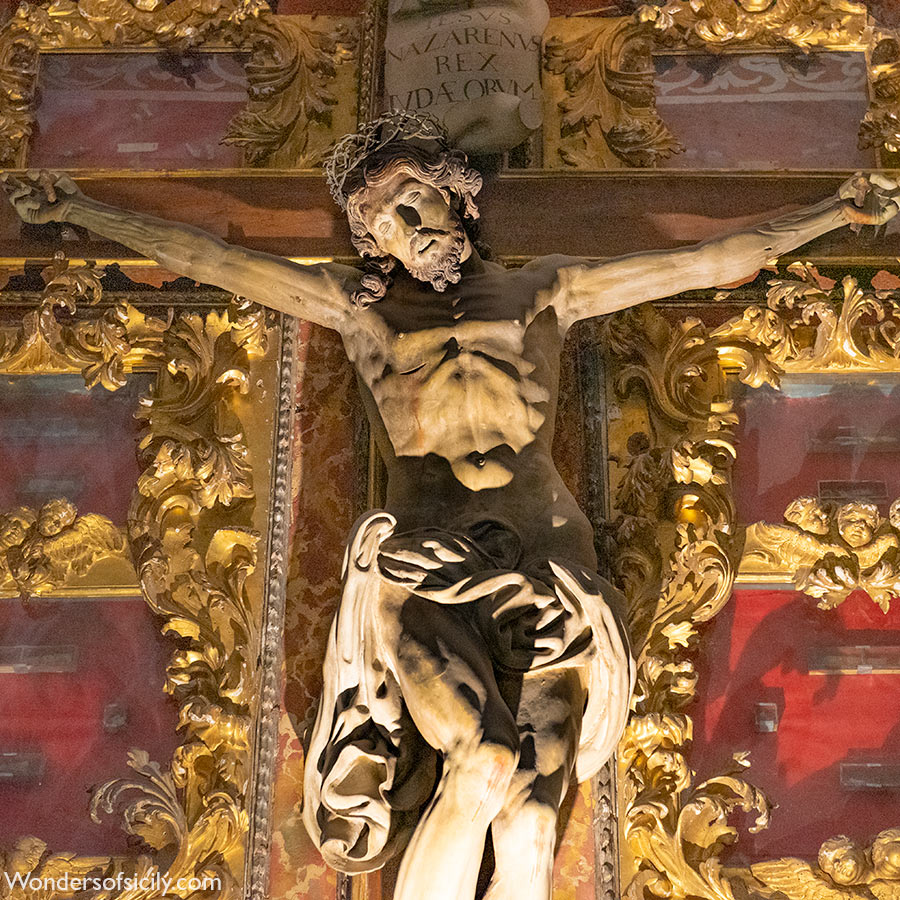
Reliquary Crucifix in the Cappella del Crocifisso (1628- 1747).

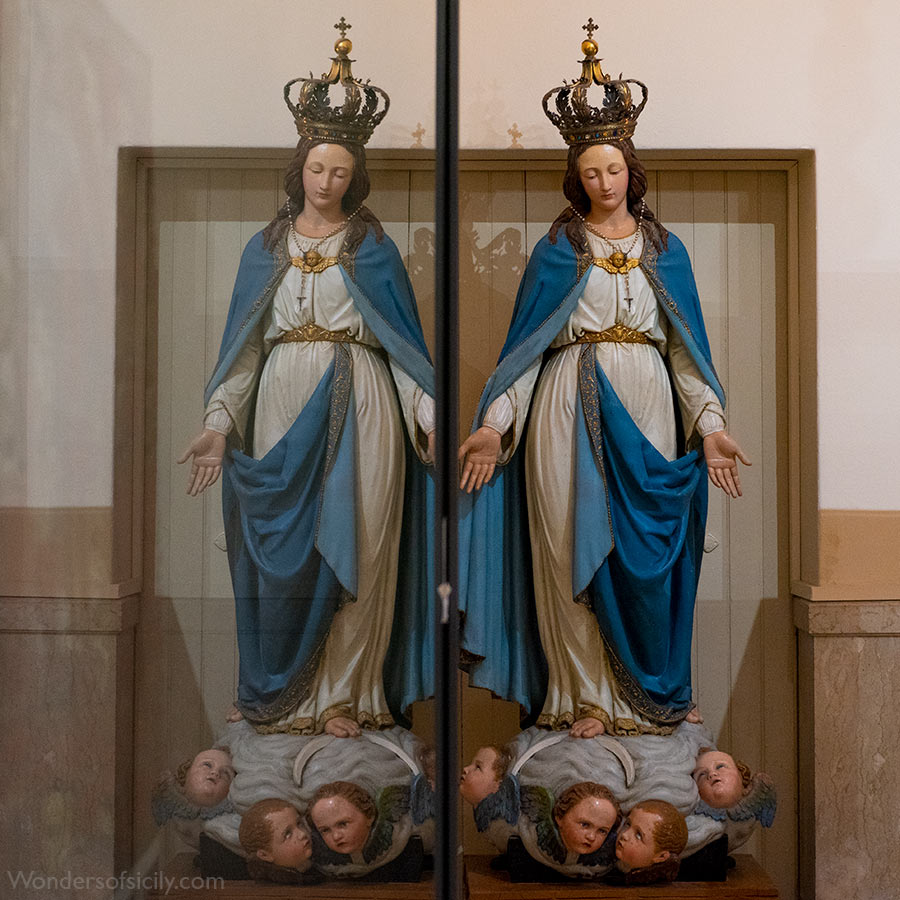
Sculpture of the Virgin (maybe set aside for restoration?) duplicated in a mirror.


This wall painting in the crypt of Casa Professa in Palermo shows the IHS monogram, a Christogram derived from the Greek spelling of Jesus (ΙΗΣΟΥΣ). Surrounded by radiant sunbeams and crowned by a cross, the symbol reflects the devotion promoted by the Jesuit order, which established Casa Professa in the late 16th century. The shining sun emphasizes Christ as the “light of the world,” a central theme in Jesuit spirituality and Counter-Reformation art.
Athanasius Kircher describes meticulously how to construct a sundial in the shape of the holy name IESV (Jesus) in his work Ars magna lucis et umbrae (“The Great Art of Light and Shadow”, 1646). Athanasius Kircher published chapter on the IESV sundial to demonstrate both his mastery of mathematical astronomy and his Jesuit mission: showing that all time belongs to Christ. In his lifetime, Kircher was celebrated as a universal genius. Today he is remembered as a brilliant but rather eccentric scholar: often wrong in his conclusions, but enormously creative, curious, and influential in spreading knowledge. His museum in Rome (the Kircherian Museum) became a prototype of later scientific museums. (It was dissolved in 1916 and its collection was granted to various other Roman and regional museums.)

Chiesa dell'Immacolata Concezione

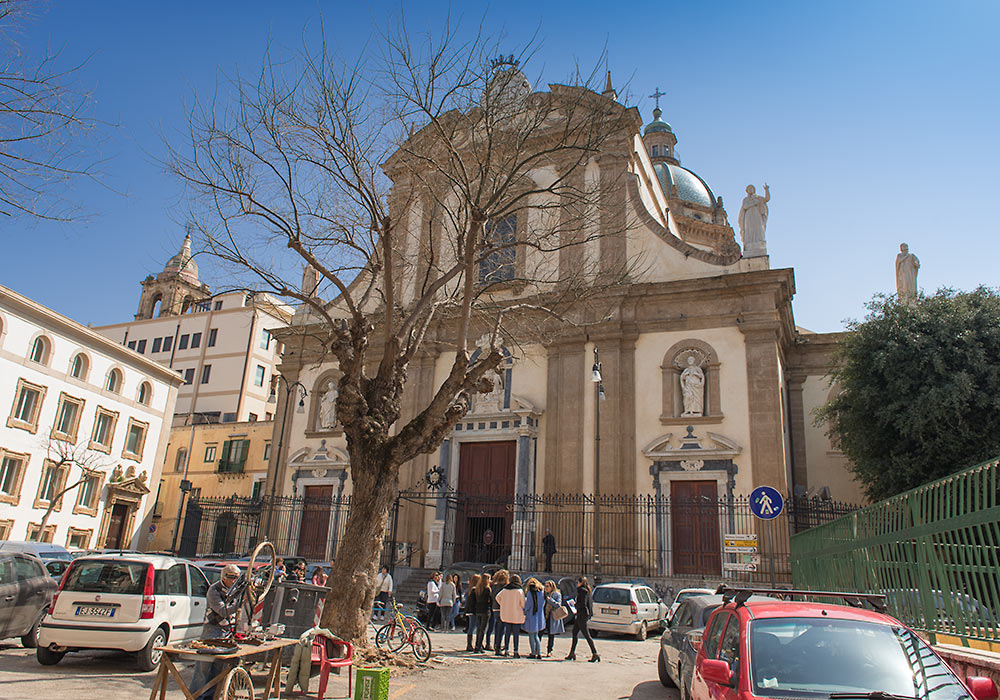
Chiesa del Gesù, Piazza Casa Professa, 1. The stucco statues of the facade date from 1634 and, therefore, are most likely to be the work of Orazio Ferraro, according to Donald Garstang (Giacomo Serpotta and the Stuccatori of Palermo 1560-1790).

Sources
Donald Garstang: Giacomo Serpotta and the Stuccatori of Palermo 1560-1790 (London, 1984)
Maria Giuffrè: The Baroque Architecture of Sicily (London, 2007)
Federica Balistreri, Il complesso gesuitico della Casa Professa di Palermo, 2014–2015. Accessed via Academia.edu.
Homepage of Chiesa del Gesù di Casa Professa
Cesare Ripa: Iconologia (1645, via Google Books/ChatGPT)